A Little Easter History with Frank

Last year we looked at the central role that Easter plays in the Christian churches. This year we will look at some lesser-known traditions of Easter. There could be Christianity without Christmas, and it was so in the first few centuries of Christianity, but there could be no Christianity without Easter, as the resurrection of Jesus is the centre point of Christianity.
Jesus went to Jerusalem to celebrate the Passover (Pesach in Hebrew), as was the standard Jewish practice at the time. His entry into Jerusalem is marked by Palm Sunday, a remembrance of the people welcoming him into Jerusalem by laying palm fronds before him.
This is the beginning of Holy Week, which is referred to as Great Week in the Eastern Orthodox Churches. A number of important dates happen during Holy Week. Maundy Thursday commemorates the Last Supper, when Jesus dined with his disciples for the last time.
On this day, Jesus also washed the feet of his disciples and said, “A new commandment I give unto you, That ye love one another; as I have loved you, that ye also love one another.” “Maundy” is derived via Old French and Old English from the Latin word “mandātum” meaning “commandment”.
Other etymologies for the word Maundy are possible. In the Commonwealth the day is marked by the Monarch giving purses of Maundy money to deserving senior citizens.
Good Friday commemorates the crucifixion of Jesus. Many are puzzled by the name of this day. Here, the word “good” is used in its historical sense of “pious” or “holy”.
Easter Sunday is the day on which the resurrection of Jesus is celebrated. Easter is named after Ēostre, a West Germanic goddess of spring. The early church named many of its observances after pagan rites or deities, in order to make them more acceptable to new converts.
The Dutch and German names for Easter have similar origins. Many other European countries have names for Easter, which are derived from “Paskha”, the Greek word for Easter, which is derived from the Aramaic word “Paskha” or Jewish Passover (Pesach). Other countries call Easter by their word for resurrection or by reference to the night long vigil held before Easter Sunday.
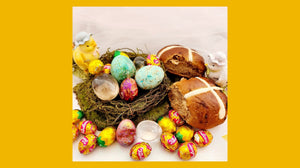
Easter eggs are eggs, which have been decorated for the holiday of Easter. The oldest tradition survives in Central and Eastern Europe, where chicken’s eggs are dyed and painted. Eggs dyed with red dye are a well-known feature of Easter in Greece. The use of eggs to represent new life predates Christianity. In addition, the shell of the egg represents the empty tomb of Jesus after his resurrection. The colouring of eggs with red dye represents the blood of Jesus shed at his crucifixion. Traditionally, the red dye was made by boiling the skins of brown onions. Eggs were a prohibited food during Lent and so gifts of eggs would be received as a welcome treat after the abstinences of Lent.
These days chocolate eggs are a continuation of this tradition. The Easter Bunny (also called Easter Rabbit or Easter Hare) is a folkloric figure. Hares were believed to be hermaphrodites and the belief that they could reproduce without loss of virginity led to their association with the Virgin Mary.
The “Easter Hare” originated among German Lutherans in the seventeenth century. He originally played the role of a judge between good and disobedient children, similar to Santa Claus’ “naughty or nice” list. He is depicted carrying a basket with coloured eggs and sweets, and sometimes toys. Hence, Easter Bunny has similarities to Santa Claus.
Hot Cross Buns are another of our Easter traditions. The different elements of the bun have specific meanings. The cross on the bun represents the crucifixion of Jesus, the spices represent the spices used to embalm him and sometimes candied peel is used to represent the bitterness of his time on the cross. Traditionally, hot cross buns were eaten on Good Friday in commemoration of the Crucifixion. These days, it seems that supermarkets would have us believe that Eastertide begins the day after Boxing Day.
Namaste
Frank